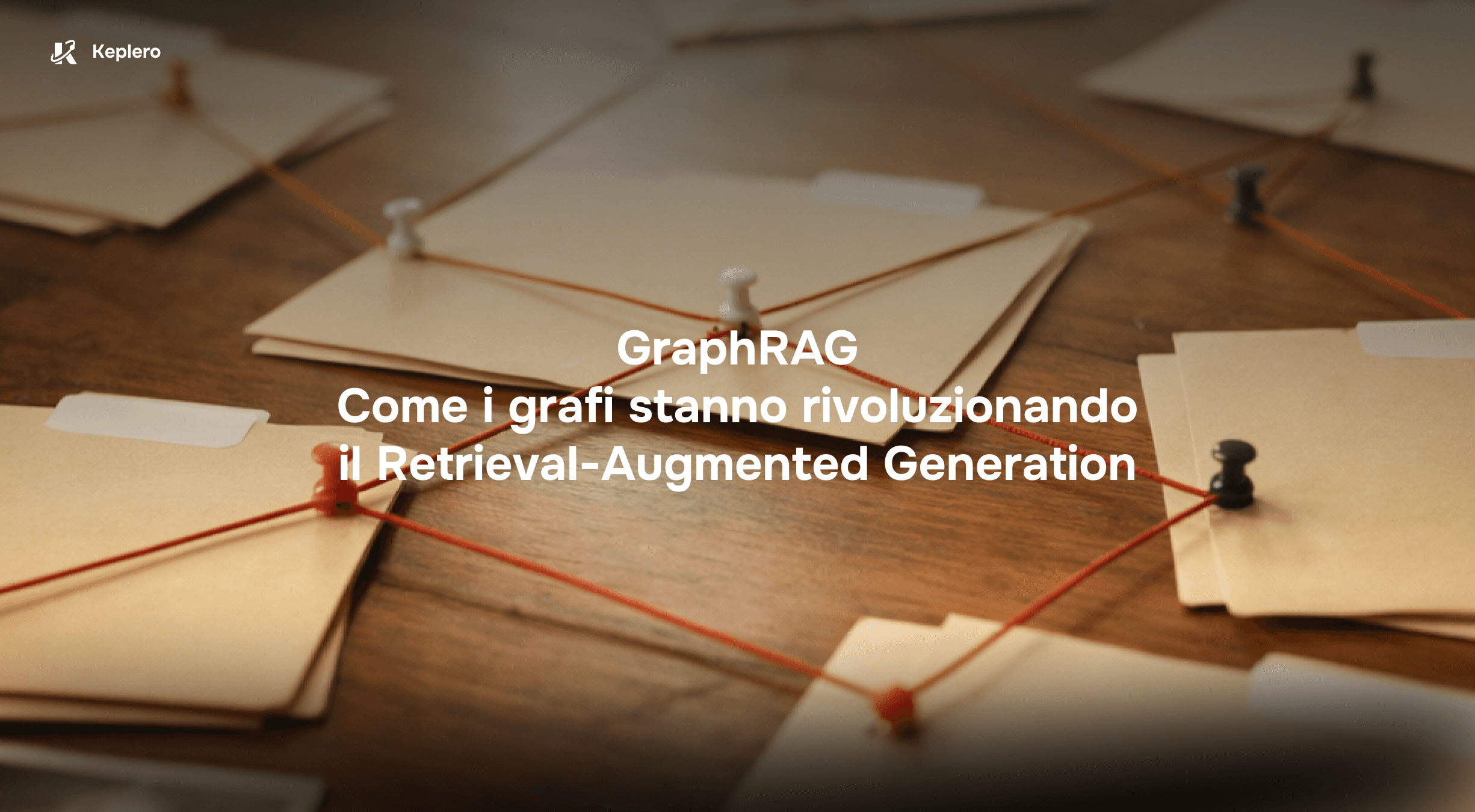
GraphRAG - How graphs are revolutionizing Retrieval-Augmented Generation
Classic RAG retrieves text chunks based on semantic similarity. It works well for simple questions, but falls short on complex ones. Graph RAG overcomes this limitation by building a knowledge graph that explicitly encodes relationships between entities, enabling multi-hop reasoning, global summarization, and structured retrieval that traditional vector stores simply can't provide.
Why Classic RAG Is Not Enough
Before understanding what GraphRAG is, it is crucial to understand what doesn't work in traditional RAG. Retrieval-Augmented Generation (RAG) is a technique that enables LLMs to answer questions by tapping into external knowledge bases, instead of relying solely on the "hardcoded" memory built into the model during training. The classic flow is simple: a query is transformed into an embedding vector, the closest text chunks are retrieved from the vector store, and they are passed to the model alongside the original question as context.
This approach works extremely well for simple, direct questions such as: "What is the capital of France?" or "What does document X say regarding Y?". But the moment questions become more complex, classic RAG starts showing deep cracks.
There are three main limitations, and they systematically emerge in all recent surveys on the topic:
1. Inability to perform multi-hop reasoning. Classic RAG retrieves text chunks in a "flat" manner, based on semantic similarity. If the answer to a question requires connecting information scattered across multiple documents—for example, "What is the currency of the country where the founder of this company was born?" —the system cannot construct the necessary logical path. Each chunk is encoded in isolation, without relationships to the others.
2. Difficulty in integrating distributed knowledge. In complex document corpora (legal contracts, medical knowledge bases, technical documentation), the same entity is mentioned in dozens of different contexts. Classic RAG does not aggregate these signals: it retrieves a few fragments and sends them to the model, which must "guess" the connections.
3. Inefficiency on global synthesis queries. Questions such as "What are the main themes of this document collection?" are impossible to answer with simple similarity-based retrieval: they require a holistic understanding of the entire corpus, not just individual snippets.
Microsoft's seminal paper, "From Local to Global: A Graph RAG Approach to Query-Focused Summarization" by Darren Edge et al. (2024), identifies precisely this dichotomy as the core issue: on the one hand, "local" questions (answerable with precise retrieval on a few chunks), and on the other, "global" questions that require a synthesis of the entire knowledge base.
What Is GraphRAG: The Definition
GraphRAG is a paradigm that extends traditional RAG by integrating graph structures into the representation, retrieval, and use of knowledge.
In simple terms: instead of storing documents as flat text chunks in a vector store, Graph RAG builds a knowledge graph in which nodes represent entities (people, places, concepts, events) and edges represent semantic relationships between them. When a query arrives, the system does not just search for the most similar chunks; it navigates the graph to construct a structured, multidimensional, and relationally coherent context.
The most comprehensive survey on the topic, published on arXiv on December 30, 2024, by a team from the University of Hong Kong, proposes a unified framework to describe all GraphRAG systems, structured around five key components:
Query Processor: interprets and decomposes the user's question
Retriever: navigates the graph to retrieve relevant information